

UCAM joins global alliance for human-centred AI at the Vatican
The Universidad Católica de Murcia has taken part in the AI for Humanity Summit, which brought together international leaders from technology, business, academia and faith
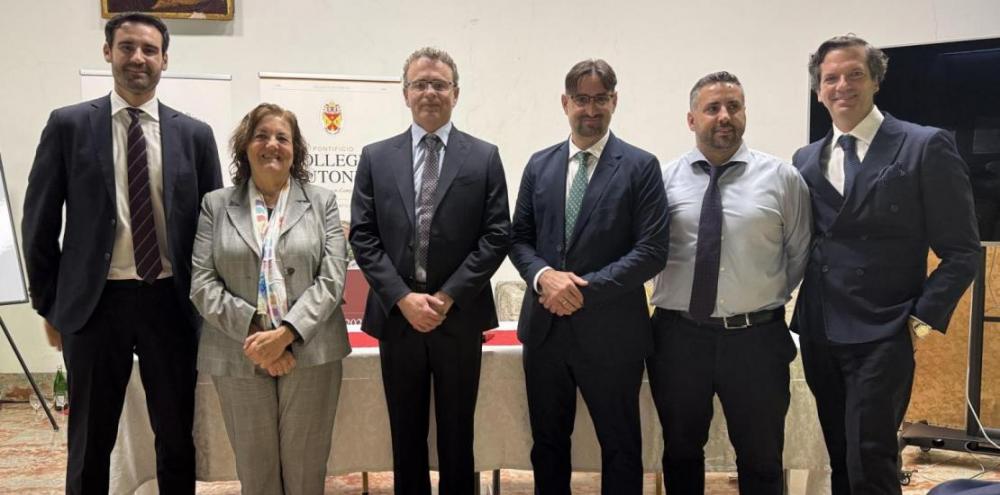

Ethical reflection on artificial intelligence has taken an important step forward at the Holy See with the AI for Humanity Summit, a forum that has established a shared roadmap to ensure that AI development remains firmly at the service of human well-being. The Universidad Católica de Murcia, represented by a delegation led by its President, María Dolores García, presented its model for the development and application of AI, placing people at the centre in response to the challenges of the new digital age.
The initiative, organised by the Magnifica Humanitas Foundation (Magnificent Humanity Foundation) and Global AI Academy, forms part of the wider discussion prompted by the encyclical Magnifica Humanitas by Pope Leo XIV, published on 15 May 2026 and devoted to artificial intelligence and human dignity.
The summit brought together 80 representatives from the fields of technology, business, academia, investment, government, philanthropy and faith. At this inaugural gathering, participants agreed to establish the coalition and ensure its continuity through future meetings and by presenting the commitments undertaken by its members to the Holy See.
Speakers included Shane Legg, co-founder of Google DeepMind and the company’s chief AGI scientist, who coined the term AGI (Artificial General Intelligence). He discussed the potential impact of increasingly advanced artificial intelligence systems and the need to address their implications from perspectives that go beyond the strictly technological.
UCAM’s participation enabled the University to present its approach to deploying artificial intelligence at this international forum. The model is based on the premise that technology should enhance, assist and multiply human capabilities rather than replace them. From this perspective, AI should help people make better decisions without taking away their responsibility or judgement.
During the summit, progress was also made in the collaboration between UCAM and Global AI Academy to promote international artificial intelligence training initiatives for the corporate sector, inspired by the principles set out in Magnifica Humanitas. The two organisations are also working on entrepreneurship hubs focused on incubating and launching technology start-ups linked to artificial intelligence.
UCAM also contributed its experience in the practical application of this technology in a university setting. The institution’s initiatives include its governed AI programme, dedicated teaching plans and the development of internal AI-based applications by staff from different areas. This strategy also has a social and educational dimension, with particular emphasis on access to these technologies for vulnerable groups and on preparing students and professionals to use them responsibly.