

UCAM celebrates Luis de la Fuente’s values as he receives an honorary doctorate
‘Sport is one of the most powerful educational tools we have,’ said the Spain head coach during a moving ceremony at UCAM’s Los Jerónimos Campus in Murcia, where the university held its Official Opening Ceremony of the 2026–27 Academic Year, marking its 30th anniversary and paying special tribute to the institution’s founder, José Luis Mendoza

With the church of the Monastery of Los Jerónimos packed, Luis de la Fuente, head coach of Spain’s senior national football team, made his entrance to prolonged, emotional applause at the Official Opening Ceremony of the 2026–27 Academic Year at Universidad Católica San Antonio, where he was awarded an honorary doctorate by UCAM as the institution marks 30 years since its foundation. From early in the morning, students, lecturers, university staff and visitors gathered in the Monastery’s corridors hoping for an autograph, a photo, a handshake or simply a glimpse of a man who has brought them so much joy and whom they deeply admire.
The academic ceremony was presided over by María Dolores García, UCAM President, accompanied by Josefina García Lozano, Rector; Fernando López Miras, President of the Region of Murcia; José Manuel Lorca Planes, Bishop of the Diocese of Cartagena; Rebeca Pérez, Mayor of Murcia; and Visitación Martínez, President of the Regional Assembly of Murcia.
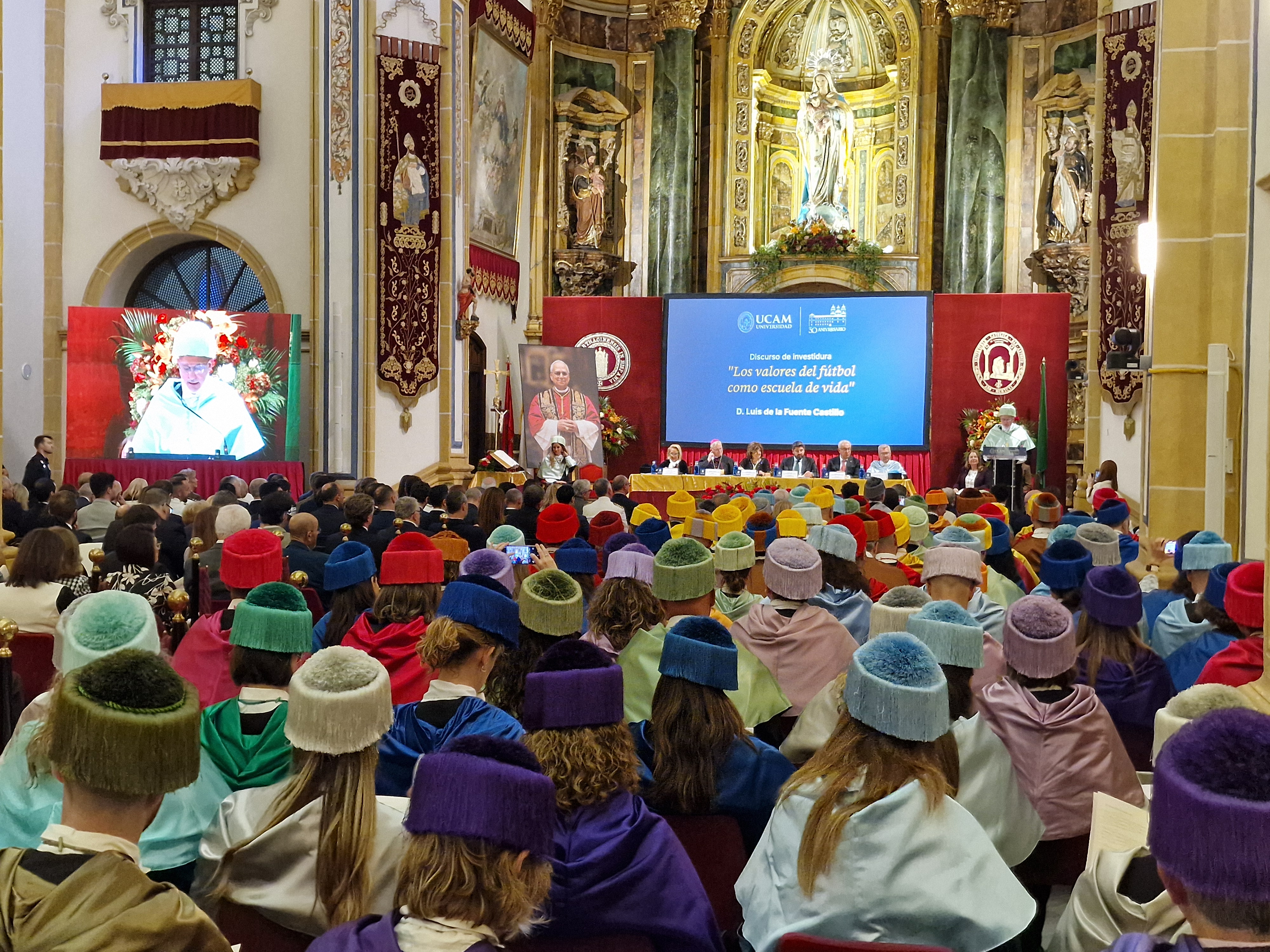
In her laudatio, Lourdes Meroño, Dean of the Faculty of Sport, described Luis de la Fuente’s career as ‘exemplary’, saying that his legacy goes beyond the impressive titles he has won and lies in his ability to inspire others. Alejandro Blanco, President of the Spanish Olympic Committee, highlighted the outstanding work De la Fuente has done throughout his career and the values he represents. Blanco said the Spain head coach is an example of how ‘knowledge is also generated outside the classroom’, adding that he fully deserves the distinction and ‘represents the work of the thousands of coaches on football pitches across Spain, helping young people develop through the sport and as people’.
‘The values of football as a school for life’
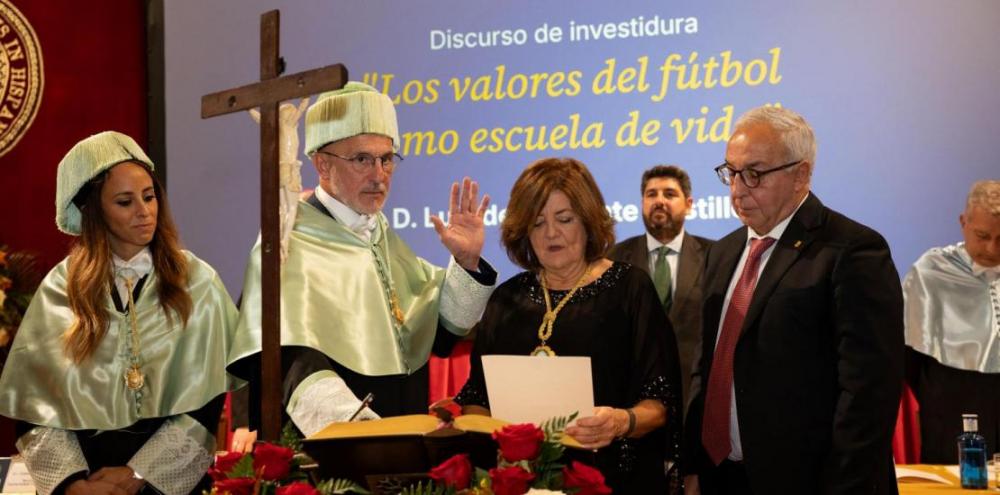
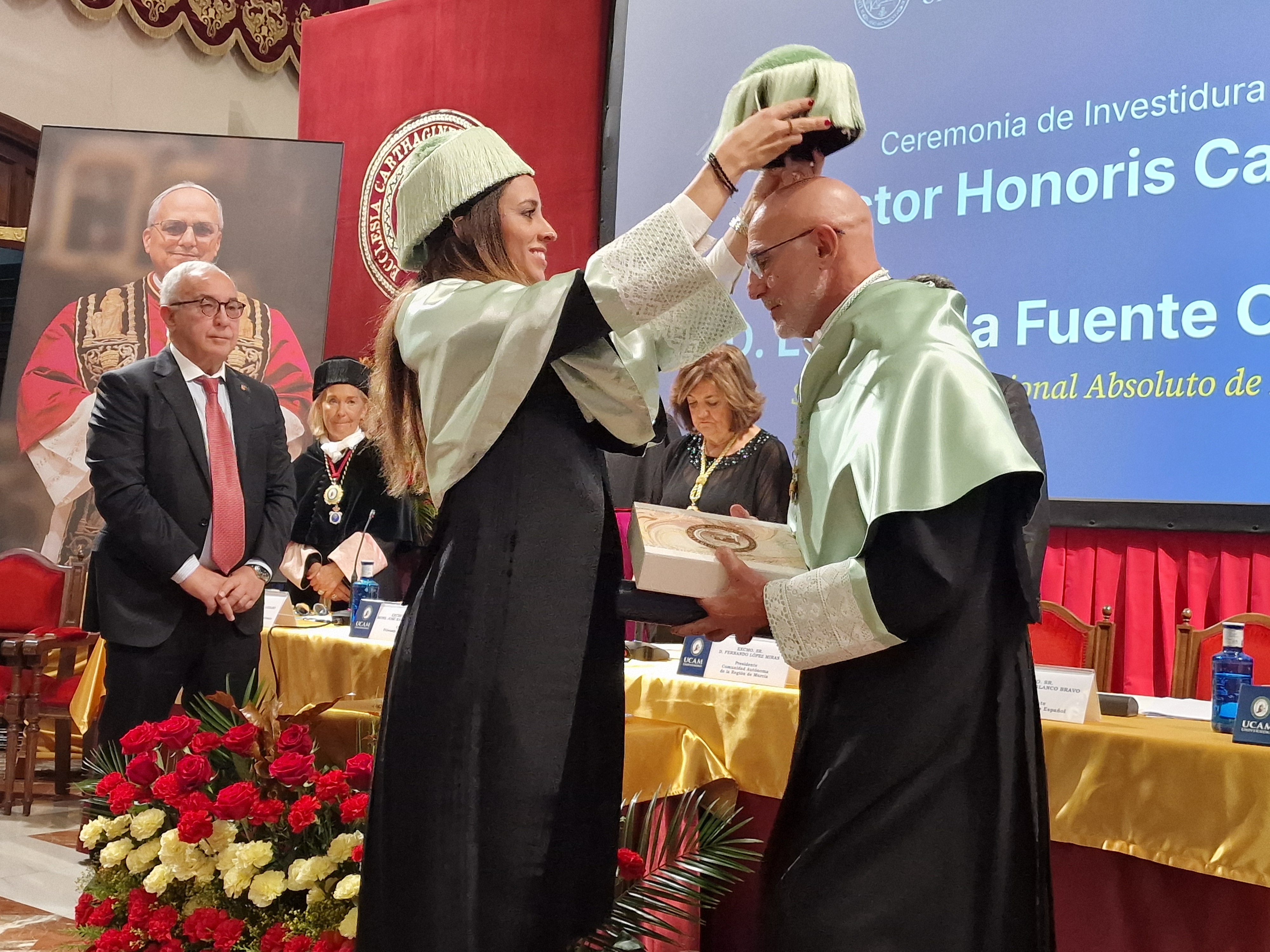
One of the most moving moments of the ceremony came when the Spain head coach received the ceremonial insignia of his honorary doctorate from UCAM (medal, white gloves, ring and biretta) and, above all, when, at the request of the University President, he took the oath confirming his appointment and commitment to UCAM. This prompted sustained applause from the University’s doctors, senior management, students and guests.
In his investiture address, ‘The values of football as a school for life’, Luis de la Fuente said that, after so many years in football, ‘if someone asked me what the most important lesson this sport has taught me is, my answer would be simple: it has not only taught me how to win; it has taught me how to live. And I believe that is the greatness of sport: it is one of the most powerful educational tools we have’.
Education and values were at the heart of his address. ‘The best teams were not necessarily the most talented; they were the ones with the strongest values. I mean respect, generosity, humility and commitment,’ he said, adding that ‘the best organisations, institutions and communities are built on those same principles’. He concluded that sport has an extraordinary capacity to transmit those values ‘through every coach, teacher, researcher, leader and athlete. We are all role models for someone’.
De la Fuente has always stressed the importance of working together to the players he has coached: ‘Individual success deserves recognition. Collective success, by contrast, has the power to transform entire communities. A team works when every member understands that there is something more important than themselves.’ He added: ‘There are groups that function as teams. And others that become something much deeper: a family.’ ‘I believe the Spain national team is an example of that,’ he said.
Beyond the values he embodies, Luis de la Fuente also has a connection with UCAM through his faith, having publicly described himself as Catholic over the years. ‘For me, everything connected with faith is a driving force in life and something very important,’ he said.
Excellence in education rooted in values
UCAM President María Dolores García expressed her joy at the Spain head coach joining the University’s body of doctors, highlighting the values he represents and lives by: ‘his example in life and the way he openly lives out his faith, speaking naturally about God and his religious convictions; a faith that accompanies him in everyday life and is a great help in maintaining peace amid difficulties’.
The institution is celebrating the 30th anniversary of its foundation this academic year. ‘Bishop Javier Azagra, then Bishop of the Diocese of Cartagena, gave the go-ahead for its creation,’ García recalled. She also remembered her husband and the University’s founder, José Luis Mendoza, ‘who had the courage to propose launching this institution in this iconic setting, when the Monastery lay in ruins’, even though ‘he could already see students in its corridors, lecturers teaching classes and investigators carrying out research’.
Speaking about UCAM’s 30 years, she said: ‘It brings us enormous joy because we can see how God has blessed this work, despite the difficulties, suffering and obstacles. Little by little, however, the doubts that existed at the beginning have faded. The results speak for themselves: we have 100,000 graduates, so many people who are now serving society thanks to the education they received.’ She thanked ‘the many families who over the years have entrusted us with the education of their children’, adding: ‘we work so that, as well as becoming outstanding professionals, our graduates are people of upright conscience who seek the truth’.
UCAM has also begun academic activity at its Madrid Campus this year, joining the campuses in Murcia and Cartagena. ‘The search for truth gives greatness to scientific knowledge. This is the challenge our academic staff have made their own. To remain who we are, we must know how to change, and at UCAM we like to stay ahead. That attitude has allowed us to be pioneers,’ said Josefina García, Rector of the University, who added that it is thanks to this approach that UCAM Madrid is now a reality. She also said the institution continues to expand its academic offering to respond to society’s evolving needs.
Fernando López Miras, President of the Region of Murcia, congratulated the Universidad Católica San Antonio on its anniversary and on forming part of the Region’s ‘strong’ university system. He noted that the institution has more than 22,000 students across its three campuses and international sites, and that behind those figures are thousands of individual stories. ‘UCAM has contributed talent to society through a culture of effort and self-improvement,’ he said, highlighting its commitment to internationalisation and research, as well as its strong focus on university-business knowledge transfer. He also announced that the Governing Council of the Region of Murcia had approved the Universities Act of the Region of Murcia this day, ‘which has been sent to the Regional Assembly to continue its passage. It is a fundamental law for our university system after 20 years, born out of dialogue and participation across the Region’s entire university system’.
Saint Teresa of Ávila
The ceremony began with Mass, celebrated by José Manuel Lorca Planes, Bishop of the Diocese of Cartagena. His homily focused on Saint Teresa of Ávila, whose feast day was being celebrated this day, 15 October, and on her wisdom: ‘Talking about wisdom at a university could hardly be more fitting.’
During his address at the academic ceremony, he highlighted how UCAM’s presence is felt throughout society and encouraged lecturers ‘to nurture the gift of faith’ and students not to lose heart in working towards their goals ‘and also to grow in the knowledge of God’.
UCAM: 30 years with sport at the heart of its identity
UCAM turns 30 on 13 November 2026. Since its foundation, José Luis Mendoza championed a model inspired by universities in the English-speaking world, bringing together academic education, research, elite competition and the transmission of values. One of its pillars is the partnership with the Spanish Olympic Committee, launched in 2012 by Mendoza and Alejandro Blanco. Through scholarships, personalised tutoring and academic flexibility, it enables hundreds of elite athletes to combine their sporting careers with their studies and has made UCAM an international benchmark for dual careers.
Olympic and Paralympic results illustrate the scale of this commitment. At Rio 2016, athletes linked to UCAM won 15 medals and nine Olympic diplomas, as well as nine medals and three Paralympic diplomas. At Tokyo 2020, the total was 23 medallists and 31 Olympic and Paralympic diplomas, while at Paris 2024 there were 15 medallists and 33 athletes awarded diplomas. Beyond the podium, the academic achievements of UCAM athletes also stand out. Those who have completed doctorates include athletes Juanma Molina and Antonio Peñalver in Sport Sciences, and Olympic taekwondo champion Joel González in Criminology. Graduates include Lola Riera in Medicine, Miguel Ángel López in Physical Activity and Sport Sciences, and Artemi Gavezou in Business Administration and Management.
In university sport, UCAM secured its 15th consecutive title as the leading university in the medal table at the Spanish University Championships in 2026, with 170 medals: 97 gold, 44 silver and 29 bronze. This record has been recognised with the Joaquín Blume Trophy twice (2012 and 2026), the International Olympic Committee’s ‘Olympism in Action’ award in 2018, and distinctions from the Spanish Olympic Committee and European Athletics, among other organisations. These honours recognise a model that, for three decades, has made sport an essential part of UCAM’s identity and its commitment to the all-round development of individuals.