

Luis de la Fuente to receive an Honorary Doctorate from UCAM
The ceremony will take place on 15 October during the Official Opening Ceremony of the Academic Year at the Universidad Católica de Murcia, which previously awarded the same distinction to Vicente del Bosque, another Spain manager who won both the World Cup and European Championship
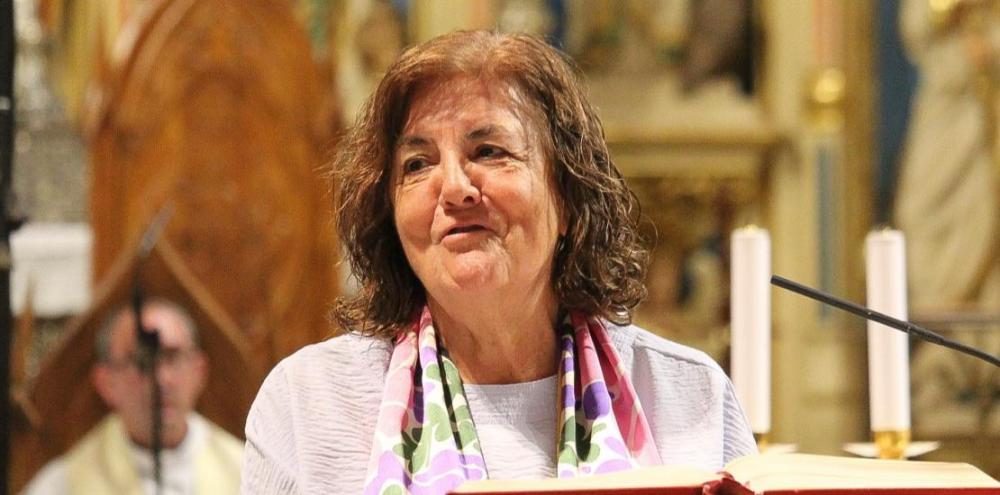

‘It is essential to recognise and highlight people who are genuine role models for society, not only because of their much-admired achievements, but also because of the values that guide their lives.’ With these words, UCAM President María Dolores García announced that Spain national football team manager Luis de la Fuente, who won both the world and European championships with Spain, will receive an Honorary Doctorate from the University. The ceremony will take place in the church of the Monastery of Los Jerónimos, the usual venue for UCAM’s formal ceremonies, as the institution marks the 30th anniversary of its foundation this academic year.
The President of the University made the announcement at Murcia Cathedral during UCAM CF’s floral offering to the city’s patron saint, the Virgen de la Fuensanta, who is currently at the Cathedral for the festivities held in her honour. García entrusted the squad to her, asking her ‘to protect them from injury and guide them so that, in every training session and every match, they can set an example of nobility and team spirit’.

Photo: RFEF
María Dolores García said that Luis de la Fuente ‘clearly embodies UCAM’s founding values: tireless effort, talent management, respect for others and teamwork as the path to success’. ‘Even more importantly,’ she added, ‘we feel a deep bond with him because of the naturalness and courage with which he expresses his faith. We live in times when it can seem that people have to hide what they believe, yet Luis de la Fuente offers us beautiful testimonies, saying quite simply: “I have faith; I pray every day and thank God. It is not superstition; it is faith, which is something personal that can also be shared with others.”’
Luis de la Fuente will therefore join UCAM’s distinguished body of honorary doctors, which in the field of sport already includes Vicente del Bosque, also a European and world champion as Spain national football team manager, and former International Olympic Committee President Thomas Bach.
UCAM, internationally recognised as ‘the university of sport’, has over 500 scholarship athletes and, through them, promotes ‘the values demonstrated in and through sport, as we always advocate alongside the Spanish Olympic Committee, whose president, Alejandro Blanco, is a true gift to us all’, said María Dolores García. The two institutions have worked closely together since 2012, creating a model that is unique worldwide and enables athletes to pursue demanding sporting careers while studying for undergraduate and postgraduate degrees, vocational education and training qualifications, languages or doctorates. Many have already completed these qualifications, while many others are currently studying at UCAM.
UCAM also has its own basketball, table tennis, football and esports teams and sponsors dozens of clubs. UCAM has been the leading university at the Spanish University Championships for 15 years and has more representatives at the Olympic and Paralympic Games than any other university in the world, including athletes, coaches and healthcare professionals.
Sport is also a key area of UCAM’s undergraduate and postgraduate teaching across a wide range of disciplines, as well as its research into health through sport and its preparation of athletes for high performance.
Sport has been part of UCAM’s DNA since its beginnings, at the initiative of its founder, José Luis Mendoza. The University has received recognition for this commitment from the International Olympic Committee and has twice received the Joaquín Blume Award from the Spanish Government: in 2012, presented by the then Prince Felipe, and in 2026 by King Felipe VI. Its work has also been recognised by Pope Francis, and UCAM has received various distinctions from European institutions.