


UCAM wins international award for innovation in healthcare education
UCAM (Europe, the Middle East and Africa), Florida State University (the Americas) and Nanyang Technological University (Asia-Pacific) were the regional winners of the 2026 Gartner Eye on Innovation Awards. The awards are run by Gartner, a global leader in technology research and advisory services, with a presence in 90 countries and over 13,000 clients
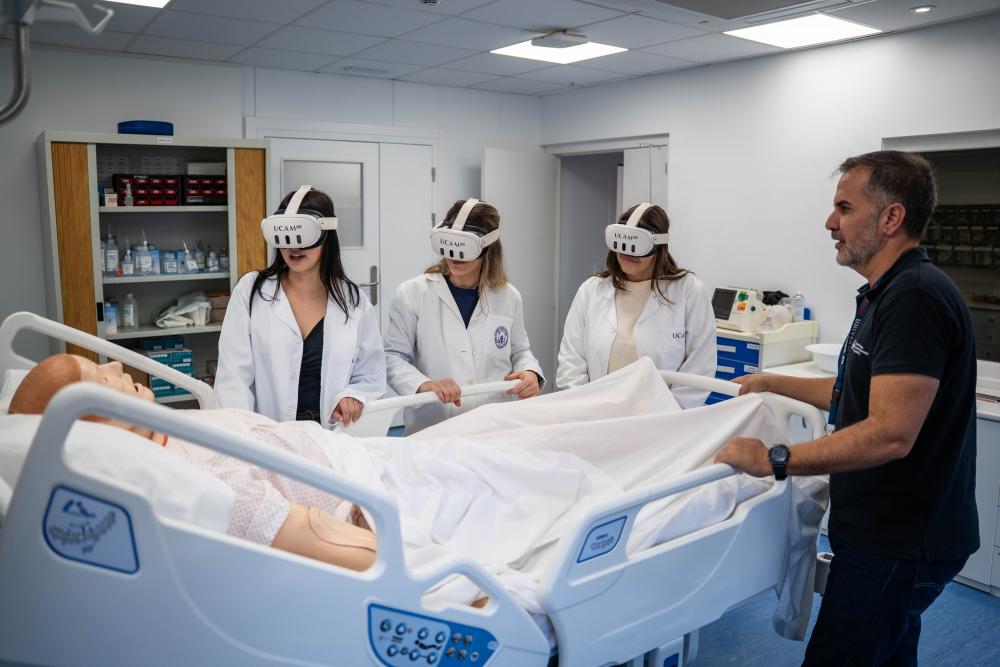

Seeing patients at a health centre, working in an emergency department or finding out first-hand how an operating theatre works are just some of the experiences that immersive technology offers health sciences students. Virtual environments allow them to familiarise themselves with situations they may encounter in their future careers before they start their clinical placements.
For several years, UCAM has been using these tools in its degree programmes. Its New Technologies for Health Research Group, led by Professor Manuel Pardo Ríos, won the Gartner Eye on Innovation 2026 Award in the higher education category for Europe, the Middle East and Africa (EMEA). The award recognised the group’s applied research on ‘Immersive Virtual Reality and Digital Twins for Higher Education in the Health Sciences’, carried out as part of the METASALUD project.
As part of the project, the team developed a virtual reality lab where students use VR headsets to practise delivering clinical care in immersive 360° simulations. In recent months, the team has also used LiDAR to create digital twins, which are exact 3D replicas of real hospital environments. The way the resources are stored allows them to be reused and adapted for different degree programmes.
The project can be used in degree programmes in medicine, nursing, physiotherapy, podiatry and dentistry. It also includes dedicated training for teaching staff and a standardised assessment system, allowing the team to measure learning outcomes and publish its findings in scientific journals.
‘What pleases us most about this award is that it recognises the value of giving students a chance to explore a work environment they rarely encounter or have limited access to, before they find themselves there for the first time with a patient in front of them. Technology only makes sense if it improves what students can do and helps them develop their skills and find their bearings more easily,’ says Manuel Pardo Ríos, the project’s principal investigator.
METASALUD, ‘Designing a Metaverse for Higher Education in the Health Sciences’ (PID2022-138884NA-I00), received funding from Spain’s Ministry of Science, Innovation and Universities through the Spanish State Research Agency, and from the European Regional Development Fund.
Gartner Eye on Innovation Awards
In the higher education category for EMEA (Europe, the Middle East and Africa), UCAM was up against fellow finalists the European University of Madrid and Ajman University (United Arab Emirates). Florida State University won in the Americas and Nanyang Technological University won in Asia-Pacific. Türkiye’s Ministry of National Education won in the primary and secondary education category.
Technology and innovation in practical training
UCAM has been developing new ways to train health sciences students for many years, gradually introducing new technologies and teaching methods. Building on its early work in clinical simulation, the university has introduced immersive tools such as VR headsets and 360° cameras and has developed digital twins and metaverse environments. These tools give students more opportunities to practise and prepare them for a range of situations, from working in a hospital to responding to disasters and emergencies.