

Veterinary Medicine students learn from the best
Miguel Valdés, one of Spain’s most prestigious equine surgeons with over 30 years of experience, recently performed several high-complexity surgeries at the new UCAM Veterinary Hospital
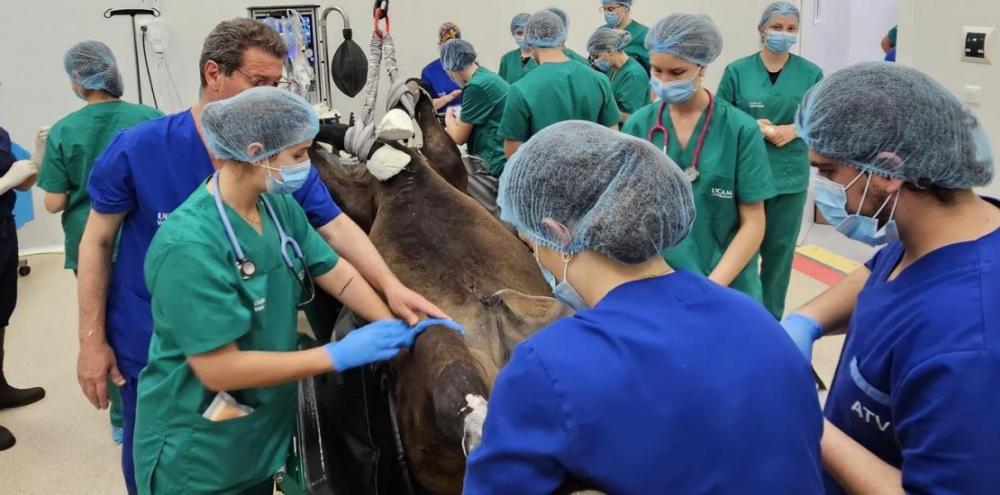

Students of the UCAM Bachelor's Degree in Veterinary Medicine have had the unique opportunity to share the operating room with Miguel Valdés, director of the renowned La Equina Referral Hospital (Manilva, Málaga). Accompanied by Isidro Ruiz, head of Equine Services at UCAM, Valdés performed various advanced procedures at the University's new facilities.
"It has been a pleasure working here, first and foremost because of the patient care, but also because of the project of growth and excellence driven by this University," stated Valdés. He also praised the cutting-edge technology at the UCAM Veterinary Hospital: "The tools are state-of-the-art... the most important asset is the human team they are building."
The Horse: The New Companion Animal
With over 700,000 horses in Spain, the sector continues to grow alongside a significant paradigm shift. Horses are no longer viewed merely as livestock; they have become companions. Valdés points to this shift in both the Region of Murcia and across Spain, where animal welfare has become a top priority.
Interview with Miguel Valdés
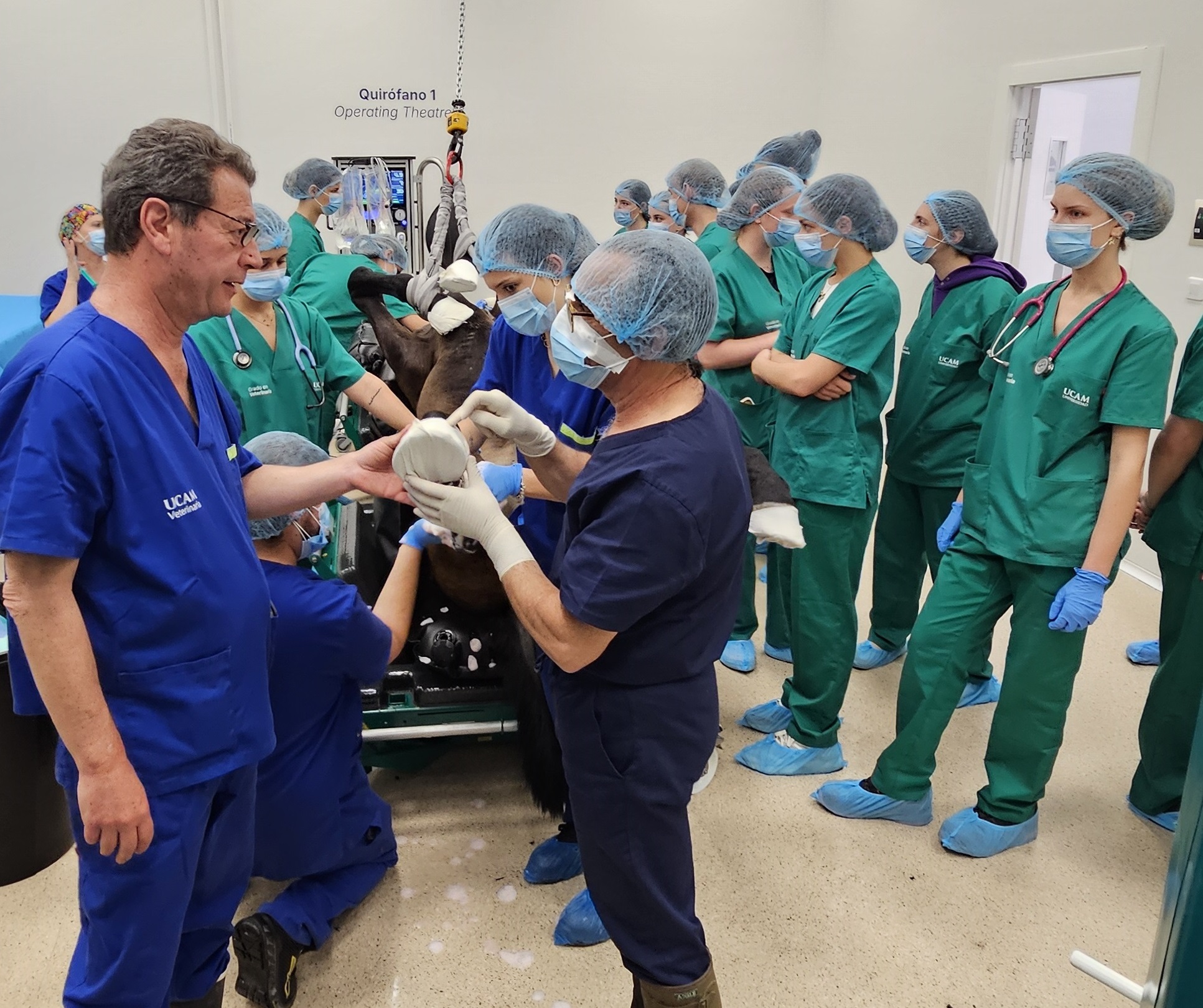
Question: What is the current state of the equine sector in the Region of Murcia?
Answer: The equine economic sector in Murcia is growing significantly and has great prospects. This growth is rooted in the bond and love for the horse. A decade ago, the concept of the horse as a "pet" was unthinkable here.
"We are seeing the same trend that Northern Europe and English-speaking countries experienced 20 or 25 years ago"
This shift is happening across Spain; we are witnessing an increase in the bond with the animal and a sense of responsibility. Animal welfare is now a priority for society.
Q: In this new scenario, has the nature of the injuries you treat changed?
A: We basically treat two types of cases: those related to sports medicine and pathologies common to the horse’s anatomy, such as gastrointestinal issues. Colic remains the number one cause of death in horses.
Q: You recently performed complex surgeries at the UCAM Veterinary Hospital. How was the experience?
A: I am very excited. It was my first time in UCAM’s state-of-the-art operating room, and there will be more to come. This was made possible by Dr. Isidro Ruiz, with whom our hospital, La Equina, has collaborated for nearly 30 years.
"The tools in this hospital are state-of-the-art. I have been a surgeon for 35 years and I have never operated with cameras and equipment of this quality, but the most important thing is the human team they are building"
Q: What specific procedures were carried out?
A: We started with the most complex cases. We treated a foal with large fragments in the stifle—a challenging joint to access arthroscopically. We also removed fragments from the distal interphalangeal joint, performed an abdominal cryptorchidectomy, and hock arthroscopies.
Q: Is the need for specialized veterinarians increasing?
A: Absolutely. Today, the veterinary profession is specialized by species. It is very rare to find a vet who treats both dogs and horses. We are specializing further; in my case, I exclusively perform equine surgery.
Q: Is there a shortage of veterinary professionals?
A: Entirely. We must make an effort to ensure we have a strong base of veterinarians who will become the specialists of the future.